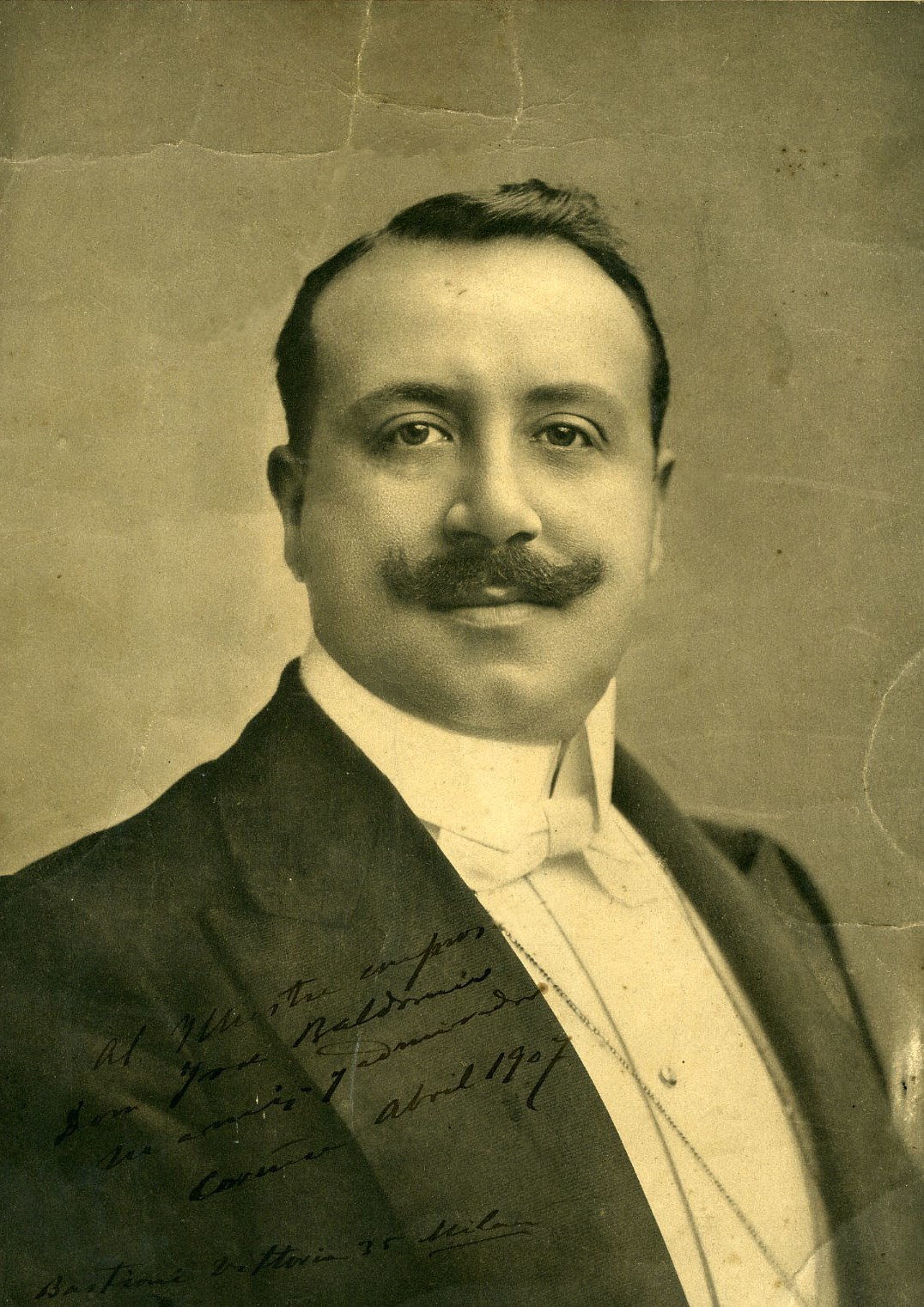
Ramon Blanchart
Barcelona 1860 - San Salvador 1934
EnglishRamon Blanchart i Ferrer was born at 2 pm on 9 July 1860 in the family home located on the second floor at 26 Basea Street, Barcelona. Carrer de Basea is a narrow lane almost opposite the Basílica de Santa Maria del Mar in the old part of Barcelona. He was the son of Pere Ramon Blanchart i Garriga, a local merchant born in Canet de Mar and Teresa Ferrer i Picarín from Barcelona. He was baptised in the Església dels Sants Màrtirs Just i Pastor six days later and received the Christian names of Ramon, Pere and Tomás. His father’s business allowed the family a typical higher middle-class status which meant that they could afford to give the boy a complete education and provide an environment in which he could develop his artistic sensibility from a very young age. His parents understood quite early that the boy had obvious artistic gifts and encouraged and supported him fully to follow that path. The budding Ramon found that he had a pleasant baritone voice and the family soon organized short recitals to display his singing. His first documented appearance dates from 18 November 1882, at the branch of the Erard piano factory in Barcelona, at the age of just 22 years and 4 months. His family and friends encouraged him to travel further afield and so he left for Madrid to be heard by the conductor, musician and voice teacher Joan Goula, who immediately accepted him as a student. Such was the potential that Goula saw in him, that he quickly organised his operatic debut at the end of that same month of November 1882 at the Teatro del Buen Retiro in Barcelona with the opera La Favorita. His success was so great that Goula himself offered him a role for his debut at the Gran Teatre del Liceu “to launch his career”, as mentioned in the newspaper El Diluvio on 24 January 1883.
Blanchart made his debut at the Liceu on 19 January 1883 in the first of five performances of the Italian version of Meyerbeer’s Les Huguenots, alongside soprano Carolina Cepeda and tenor Roberto Stagno. Originally, he was only expected to sing the first performance but audience acclaim ensured that he sang the role of Nevers in all five performances. It was the beginning of a glorious and very long career. In August and September of the same year he participated again in the season of the Teatro del Buen Retiro singing operas such as I Puritani, La Favorita or L’Africaine, always with Joan Goula as mentor. Goula secured the baritone’s debut in December 1883 at the Teatro San Fernando in Seville in two performances of La Favorita. Gradually, the audience discovered a singer who prepared his roles carefully and possessed a beautifully lyrical baritone voice and a magnificent stage presence. In 1884 he began to alternate the seasons in Barcelona theatres with other engagements throughout Spain: in April 1884 he sang La Favorita again in Seville with the tenor Lorenzo Abruñedo, in Oviedo, he appeared in L’Africaine, and then in La Favorita during October at the Teatro Jovellanos in Gijón, again with Abruñedo. Just before that came his first international foray: L’Africaine at the Teatro Baquet in Porto, in August. On 15 March he made his debut at the Teatro Real in Madrid in a single performance of Les Huguenots, standing in for no less than Mattia Battistini. This debut was most likely due to the efforts of Joan Goula, who conducted the performances. At the same time, he was included in the rosters of the Buen Retiro and Lírico theaters in Barcelona, in an important company led by Roberto Stagno, thus allowing him to enlarge his repertoire. He ended the year 1884 with his debut in Palma de Mallorca, at the Teatro Principal, in L’Africaine.
During those early years he invariably received positive reviews. La Correspondencia Musical of 25 September 1884 said that “he does not lack qualities which, accompanied by the necessary studies which he has not yet completed, will make him a useful dramatic singer”. He continued his training and gained experience with increasingly important engagements. Thus, on 19 April 1885, he returned to the Gran Teatro de Liceu with the first of several performances of La Favorita, and during the month of May he sang L’Elisir d’Amore again alongside Angelo Masini. On 12 June 1885, Ramon Blanchart starred in the first opera sung in Catalan in the history of this theatre with the world première of Lo Desengany (The Disillusionment), an opera written and conducted by the Catalan maestro Artur Baratta. The year closed with new operas at the Teatro Buen Retiro, such as Poliuto in September with the tenor Arturo Bruno.
In 1886 Blanchart undertook a tour of several Spanish cities such as La Coruña, Cádiz, Jerez, Madrid (he made his debut in September at the Teatro Princesa with La Favorita with the tenor from Manacor, Ángel Massanet) and Bilbao. In the latter city he took on a new role in November: Figaro in Il Barbiere di Siviglia at the Teatro Gran Vía. In August the tour was interrupted by a new production of La Favorita in Portugal, this time at the Coliseo dos Recreios in Lisbon. He closed the year of 1886 by singing L’Africaine at the Teatro Cervantes in Málaga. From 19 to 30 March 1887 he appeared at the Teatro Principal in Alicante with a company led by soprano Carolina Cepeda. The Barcelona newspaper La Vanguardia quoted the local press on 31 March 1887 regarding the young singer’s performance as the Conte di Luna:
…the baritone, Mr. Blanchart deserves our praise and congratulations, owing to the great results he achieves; his voice is powerful, full, beautiful, with a distinctive timbre. He phrases with feeling and his expressiveness is captivating; he sang very well in the trio in the first act; in the aria he was magnificent and in the final scene of the opera he was granted a big ovation by his use of an original variation which created an excellent effect.
On 26 April 1887 he sang his first Wagnerian opera, Tannhäuser, at the Gran Teatre del Liceu in Barcelona with Mila Kupfer-Berger. On 30 April he appeared in L’Africaine again with Kupfer-Berger and, as Vasco da Gama, Julián Gayarre.
Blanchart then travelled to Madrid, where important engagements at the Teatro Real awaited him (he would eventually become the singer who appeared the most often at that theatre before its closure in 1925); he was present in the Spanish capital from 9 October, where he appeared in I Puritani, with Francesco Marconi, until March 1888. He also took part in other operas such as L’Elisir d’Amore, with Fernando De Lucia; Pacini’s Saffo, with Eva Tetrazzini; Un Ballo in Maschera, Aida; Il Barbiere di Siviglia, again with De Lucia, or Ricci’s Crispino e la Comare in which, on 12 February 1888, he sang with Adelina Patti.
Despite having obtained national recognition, his career was lacking an international dimension. Blanchart was aware that he needed to be heard abroad beyond Spain and Portugal. Thus, in October 1888, after having sung again in the season of the Teatro Lírico in September, he left Barcelona to make his debut in Italy, at the Teatro Filodrammatici in Milan, with four performances of La Favorita with the tenor Giuseppe Cremonini who, a few years later, would star in the world première of Puccini’s Manon Lescaut. Blanchart’s remarkable debut in Milan was the right visiting card for theatrical agents who quickly hired him for new performances. He ended the year again in Barcelona, now at the Teatro Novedades, and in Seville at the Teatro San Fernando, but immediately afterwards in January 1889 he made his debut at the Teatro Argentina in Rome with Aida alongside the tenor Eugène Durot.
Later on, he embarked on his first intercontinental tour which in April and August took him to the Teatro Politeama Argentino in Buenos Aires, where he sang in Aida, with Francesco Signorini and in Don Giovanni with Patti, following this up with a tour of Uruguay. Again, La Vanguardia quoted the local press (in this case the Buenos Aires newspaper El Nacional) praising the young baritone (15 June 1889):
The honours of last night’s performance go, first and foremost to Madame Patti and to Mssrs. Marcassa and Blanchart. Mr. Blanchart, as the dissolute womaniser, proved to be the worthy artist that the impresario Ciada promised us. In full possession of his vocal means, he did justice to the heartfelt melodies and lively arias which he sings in this opera. His diction was excellent in the duet ‘La ci darem la mano’ and the Serenade. This latter piece had to be encored.
Back in Europe, he was heard again in Lisbon and Porto. He then made his debut in Russia: between the months of March and May 1890 he was part of a company led by Angelo Masini, who was idolised by the Russian audience. Blanchart sang with him in I Puritani and La Favorita in Moscow and St. Petersburg.
In 1891 Blanchart assumed a very important role: Iago in Otello, which he created locally at the Teatro Carlo Felice in Genoa. His debut took place on 24 January, appearing with one of the great protagonists of the title role, Giovanni Battista de Negri, and with Cesira Ferrani as Desdemona, who in 1896 would be chosen by Puccini as the first Mimì in La Bohème. Blanchart also appeared in Genoa in the title role of Thomas’s Hamlet. He returned to the Teatro Carlo Felice the following year with two operas that he would sing only very occasionally: Verdi’s Simon Boccanegra and Mascagni’s L’Amico Fritz, both with the Catalan tenor Francesc Viñas and conducted by Arturo Toscanini.
Blanchart returned to Barcelona already established as one of the most important baritones of his time. On 17 April he sang again in Otello at the Gran Teatre del Liceu, on this occasion with its creator, Francesco Tamagno, and the soprano Eva Tetrazzini. After four more performances in this role, he appeared from 30 April until 8 May, for the first time at the Liceu, in the title role of Amleto with the soprano Emilia Corsi. That same month, Blanchart sang Otello again, this time with Eugène Durot, at the Teatro Alighieri in Ravenna. On 23 November he made his debut in a new role at the Liceu: Il Vascello Fantasma, the Italian version of the Wagnerian opera Der fliegende Holländer, with the soprano Teresa Arkel and the tenor Ernesto Colli, who years later would be the teacher of another illustrious Catalan singer, Hipólito Lázaro.
In December 1892 and January 1893, Blanchart again appeared in new performances of Otello with a new tenor: Franco Cardinali. In just over a year, he had appeared in this opera alongside all the many celebrated tenors who were singing this role at the time. At the end of the Liceu season, where he also performed the title role of Macbeth, he returned to Genoa to sing in Lucia di Lammermoor on 12 April with a young soprano who would soon become world famous, Helen Porter Mitchell, otherwise known as Nellie Melba.
In February 1893, in Milan, the première of Verdi’s final opera, Falstaff, took place, and Blanchart was one of the first baritones to add the new opera to his repertoire. He sang the title role for the first time in June 1893 in Berlin, in one of the first performances given outside Italy. He made the Shakespearian fat knight one of his most important creations, and the main theatres quickly wanted to hear him sing it: in December at the Teatro Regio in Turin and in 1894 in Florence (with Fenton played by a very young Giuseppe Borgatti), in Genoa and in Bologna, conducted by Toscanini. Blanchart also starred in Alberto Franchetti’s new opera, Cristoforo Colombo, following its première with Giuseppe Kaschmann in the title role at the Teatro Carlo Felice in Genoa on 6 October 1892. Blanchart appeared in many subsequent performances of this opera in the Italian provinces: in November 1894 at the Teatro Sociale in Treviso, in Bologna under the direction of Toscanini, in January 1895 again in Genoa, in March in Pisa, in June at the Teatro La Fenice in Venice and at the Teatro Sociale in Trento. Earlier, however, on 24 May 1895, Blanchart had starred in a new world première at the Teatro La Fenice: Emma Liona, by Antonio Lozzi appearing alongside the tenor Umberto Beduschi.
Although Lisbon was one of the cities in which he had often sung since the start of his career, it was not until 1896 that his debut at the Teatro São Carlos took place: on 4 January he appeared in L’Africaine with the Catalan soprano Carme Bonaplata and Francesco Marconi. He later sang with the same colleagues in Les Huguenots, which was followed by performances of La Gioconda and Irene by the Portuguese composer Alfredo Keil, again with Bonaplata but now with the tenor Giuseppe Moretti. The Portuguese season ended on 29 February with Massenet’s Manon starring the soprano Hariclea Darclée, who would sing the title role in the future world première of Tosca.
In April 1896 Blanchart returned to the Liceu in Barcelona, this time to sing in the local première of Falstaff. On the first night, 18 April, he sang the aria ‘Quando ero paggio’ three times to an enthusiastic audience, something which was repeated on each of the eight performances that were offered. The cast was completed by Guerrina Fabbri, Eva Tetrazzini and Giuseppe Moretti alternating with Fiorello Giraud. La Vanguardia (19 April 1896) referred to his performance as Sir John Falstaff:
There must be a separate and outstanding mention of the baritone Blanchart, who, has obviously prepared the role with great care. He dresses, sings and acts in a manner worthy of the highest praise.
He then starred in a new première, now in Madrid, of Der fliegende Holländer, conducted by his friend Joan Goula on 27 October. He continued to participate in the season of the Teatro Real with works such as Les Huguenots and Hamlet, and closed the year at the Liceu in Barcelona with performances of Otello, Falstaff and La Gioconda.
Between 1897 and 1901, the seasons of the Teatro Real in Madrid and the Gran Teatre del Liceu in Barcelona were the central axes of his performances. His great capacity for work, learning and professionalism made him an essential artist in the main works of the season’s repertoire. Also worth mentioning is his participation in operas which he had not sung for years such as Il Trovatore in May 1897 in Barcelona, with the tenor Valentin Duc, and new roles such as Telramund in Lohengrin in November of the same year in Madrid, (alongside Hariclea Darclée and Emilio de Marchi), Rigoletto in March 1898 in Madrid, with Alessandro Bonci, and the première, on 20 March 1898 again in Madrid, of the opera Il Gladiatore by Giacomo Orefice. He also participated in 1898 in the season of the Teatro Novedades, in operas such as Rigoletto, Faust and Aida. On 6 December 1898 he was again the protagonist of a première: Gonzalo de Córdoba by Emilio Serrano, in which Blanchart sang with the Catalan tenor Jaume Bachs, known professionally as Angelo Angioletti. On 15 December 1900 he was one of the protagonists of the Madrid première of Giacomo Puccini’s new opera, Tosca, together with Eva Tetrazzini and Fiorello Giraud. Following those performances, he added the character of Scarpia to his repertoire, a role that became one of his great warhorses and which fitted perfectly with the vocalism and stage presence of the singer. Blanchart was also very careful to dress all his characters impeccably, a fact that was always widely highlighted in the press reviews.
In December 1901 our baritone sang for the Wagnerian Association of Barcelona, based in the Carrer de la Canuda, where he performed Wotan’s final scene from Die Walküre. He immediately returned to the season at the Teatro Real in Madrid remaining there until March 1902. On 30 March 1902 Blanchart took part in the Barcelona première of Tosca, at the Gran Teatre del Liceu, with the soprano Carme Bonaplata. She also starred with him in Tannhäuser around that time.
As a remarkable fact, it should be noted that on 6 April 1902 Blanchart sang Tosca at 3:30 pm and Tannhäuser at 8 pm, which gives us an idea of his exceptional stamina. In addition, he agreed to replace the baritone Franco Nicoletti (who had been the subject of protests) in La Gioconda on the night of 23 April, despite having to sing in Aida, with Avelina Carrera and Josep Palet, the next day. On 18 May he sang Don Giovanni for the first time in Spain, on this occasion in Madrid, and then in Barcelona, on 16 August, at the Tivoli Theater accompanied by the soprano Angelina Homs, the mother of a thirteen-year-old girl who would soon afterwards begin a dazzling singing career: Graziela Pareto.
After participating in the Valencia season, at the Apolo and Principal theatres, Blanchart embarked on a new tour of America. In Mexico, at the Teatro Renacimiento, on 28 September, he appeared in Aida with the soprano Rosalía Chalía (who appeared as Chalía Herrera); later, he participated in performances there of Tosca and Otello. He was then to join the same company to visit Havana, where, throughout December, he appeared in Tosca, Aida, La Favorita and Otello. In Europe, the seasons of Lisbon and Barcelona awaited him again. In Lisbon, at the Teatro São Carlos, on 27 February 1903, he was the “remarkable” Scarpia of three of the most historic performances of this opera in Portugal, with Hariclea Darclée, creator of the role, who sang alongside him as Floria Tosca, and with a young Enrico Caruso, only twenty-nine years old, as Mario Cavaradossi. The Lisbon critics described it as a “dream cast”. Blanchart ended the season in March singing Il Trovatore, again with Darclée, and then reopened the spring season of the Liceu in Barcelona, this time with L’Africaine, on 12 April, with Julián Biel. During these performances, specifically on the night of 22 April, the debut of another Catalan tenor took place: Joan Valls (more commonly known as Giovanni Valls).
Blanchart then assumed a new Wagnerian role: Kurwenal in Tristan und Isolde, sung in Italian as was then the rule. Here he shared the stage with one of the most important Italian Wagnerian tenors of the time: Guido Vaccari. Always in demand by his esteemed Wagnerian Association, on 18 June 1903 he took part in a recital with the tenor Joan Bofarull and then starred in two new premières at the Liceu. The first took place on 18 November, La Damnation de Faust in thirteen successful performances; it was a première of the stage version, since it had previously been performed in the original format as a cantata in three performances in March 1886, conducted by Antoni Nicolau. The second, on 3 December 1903, was a world première of an opera in Catalan: Acté by Joan Manén, with sets by Francesc Soler i Rovirosa, who recycled the staging of Anton Rubinstein’s Nerone (premièred at the Liceu in 1898). Three performances of this opera were offered with Blanchart, Maria Giudice, Angelo Angioletti and Concha Dahlander, conducted by the composer himself.
At the start of 1904 Blanchart was in Barcelona, where on 2 January he sang the role of Belcore in L’Elisir d’Amore, which marked the debut of the tenor Alessandro Bonci at the Liceu. He also took part in new performances of La Damnation de Faust and L’Africaine with Francesc Viñas, and Aida in April, with Salomea Krusceniski and Manuel Izquierdo as Radames. Before this, however, he appeared in two performances of Aida in Valencia on 28 January and 1 February with Avelina Carrera and Angelo Angioletti. For the rest of the year, Blanchart toured South America once again, taking him to towns such as Rosario de Santa Fe and Tucumán. In early 1905 he returned to Europe. In May 1905, in Málaga, he sang in Otello and L’Africaine with Antonio Paoli and then left for a new season at the Teatro Real in Madrid. On 25 November 1905, the Liceu was scheduled to open with Aida but, due to the indisposition of the baritone Enrico Nani, it was postponed to the next day, 26 November; Blanchart travelled urgently from Madrid to take over the part of Amonasro. He remained in Madrid until February 1906 singing his usual repertoire of Les Huguenots, Il Trovatore and Tosca, also taking part in the Madrid première of La Damnation de Faust, on the night of 2 February 1906, with Celestina Boninsegna and Manuel Izquierdo.
On 15 April 1906, he once again inaugurated the spring season of the Liceu de Barcelona, this time in Tosca with Hariclea Darclée and Amadeo Bassi:
(…) Mr. Blanchart is an excellent artist, his singing in the second act was remarkable and was much appreciated by the audience
(La Vanguardia, 16 April 1906).
This was followed by the world première, on 21 April, of Bruniselda, by Enric Morera. The opera was sung in Italian (it would not be sung in Catalan until June 1906 at the Teatro Bosque) and was conducted by Joan Lamote de Grignon. However, on 6 May Blanchart sang in Catalan the hymn which concludes the second act and again on 10 May, as a tribute to the composer; the soprano Avelina Carrera also sang an encore of her second act aria as requested by the audience.
1907 was an important year in Blanchart’s career. He began the year at the Teatro Real in Tosca (with Gemma Bellincioni and Giuseppe Anselmi), La Traviata and a rare work, the oratorio Mosé by Lorenzo Perosi. He closed the season on 2 March with his signature role of Hamlet, with the Catalan Maria Barrientos. After proceeding to Málaga’s Teatro Cervantes to sing Carlo Quinto in Ernani in May 1907, Blanchart then embarked on an important journey which would enable him to conquer one of the few places where he had not yet sung: the United States. As part of the San Carlo Opera Company, he travelled to Boston where he made his debut on the evening of 9 December 1907 at the Majestic Theatre with La Gioconda, alongside the tenor Florencio Constantino. Blanchart maintained an important artistic relationship with the Basque tenor and appeared many times with him on long tours from the end of December 1907 until the early months of 1908. Chicago, Philadelphia, Washington, Baltimore, Saint Louis and Indianapolis. All these cities heard Blanchart and Constantino in operas such as Aida, Carmen, Les Huguenots and Lohengrin. The main American newspapers recognised the artistic merits of the Catalan baritone, achieved over the course of a long career, and reported his many successes. In the United States he quickly became one of the favourite singers of the public, especially in Boston, where he secured his position as one of the leading baritones. He only interrupted his long stays in America to go back to Spain to sing in a single theatre: the Liceu in Barcelona, where he returned at the end of 1908 to participate in the inauguration of the new season. On 23 October he was in Aida with Francesc Viñas, then Rigoletto with the tenor Pietro Schiavazzi and later Tannhäuser and Dinorah. On 6 January 1909, in a performance of Tannhäuser, Viñas and Blanchart, at the request of the members of the Wagnerian Association, sang for the first time different fragments in Catalan, in the translation made by Joaquim Pena: in the second act, Wolfram’s song and, in the third, from the beginning of the second scene, ‘O Star of Eve’, to the account of Tannhäuser’s pilgrimage to Rome (La Veu de Catalunya, 8 January 1909). The following day Blanchart appeared in a new première for the Liceu and Barcelona: L’Attaque du Moulin by Alfred Bruneau, conducted by the composer. Seven performances were given. Blanchart’s abilities were on display on the evening of 10 February when the baritone sang Tannhäuser in the afternoon and L’Attaque du Moulin in the evening. The season continued with Aida and Lohengrin, both with Francesc Viñas. On the evening of 4 February, Blanchart and Viñas sang a large part of Lohengrin in Catalan, which brought the theatre audience to its feet, as did the next opera, Tristan und Isolde, that they both performed in the following season, commencing 1 December 1909; the entire third act was sung in Catalan in all four performances given.
The 1909-1910 season continued with Tosca and La Gioconda. In 1910 new local premières took place both at the Liceu and Barcelona: Tiefland by Eugen d’Albert, on the evening of 18 January 1910. The Italian translation, billed as Terra Bassa, was sung by Blanchart and the tenor Josep Palet. The first performance was attended by Àngel Guimerà, the author of Terra Baixa, the source of Rudolf Lothar’s German libretto.
After the Barcelona season, Blanchart returned to Boston and on 23 February he appeared once again in Les Huguenots, alongside Celestina Boninsegna and Florencio Constantino. He remained there without interruption for the next four years. His prestige was widely recognised in the city and, in 1911, the New England Opera of Boston announced the opening of a singing school under the direction of Blanchart and maestro Arnaldo Conti. His singing engagements, however, did not decrease and in 1911 Boston heard him in such important roles as the sheriff Jack Rance in the new Puccini opera La Fanciulla del West, with Carmen Melis and Florencio Constantino, together with the role of Captain Burton in the world première on 3 March 1911 of the opera The Sacrifice by Frederick Converse with the soprano Alice Nielsen and Florencio Constantino. Blanchart continued to be active in 1912 and 1913, always taking part in the American seasons of Boston, Hartford and Philadelphia. On 23 January 1914, he was the Hans Sachs in the Boston première of Richard Wagner’s Die Meistersinger, with the tenor Karl Jörn and the soprano Johanna Gadski. The baritone devoted much of the rest of the year to his school.
In 1915 Blanchart made his last visit to Barcelona. On 7 December he again performed the title role in Falstaff with Dolors Frau as Mrs. Quickly followed by Tannhäuser, again with his great friend Francesc Viñas. On 1 January 1916 he took part with great success in the Barcelona première of La Dolores by Tomás Bretón, with Dolors Frau and Josep Palet. Six performances of this zarzuela were given. On the night of 15 January 1916, in a performance announced as “Farewell to the baritone Ramon Blanchart”, he performed La Dolores and the first scene of Act Three of Un Ballo in Maschera with soprano Josefina de Mauro. This was his final performance at the Liceu and in Barcelona.
Blanchart returned to Boston, where he gave some occasional performances, although in 1917 and 1918 he appeared in some recitals alone or accompanying his students. In November 1918 he took part in a series of semi-staged performances of Carmen at the Orpheum Theatre in Boston.
The venue, formerly known as the old Park Theatre, had as its patrons Ramón Blanchart, José Mardones, Maria Barrientos and Hipólito Lázaro. The inauguration took place on 18 April 1919 of that year with a performance of Maruxa by Amadeu Vives, featuring the voices of Blanchart, Adelina Vehi and Isabel Marquetti. On 1 May 1919, Marina by Emilio Arrieta was scheduled, again with Blanchart, and on 11 May he appeared in a concert with Maria Barrientos and José Mardones. The venture eventually failed and no further performances were given.
Blanchart then completely retired from the operatic stage, preferring to devote himself entirely to his singing school and to lecturing and writing articles in the musical press, who held him in great esteem. In 1920, however, the Boston Opera programmed L’Elisir d’Amore, only to discover on the morning of 3 March that their bass was indisposed. With no other possible alternatives, they asked Blanchart if he would save the show and so he did: he sang the role of Dulcamara at the age of sixty-one, in a single performance that closed a glorious career at the highest artistic level which had lasted some thirty-seven years.
In the last years of his life Blanchart retired to El Salvador, in Central America, residing in the capital, San Salvador, where he acquired some property and set up various businesses, although he would also take every possible chance to teach singing. He died there on 11 August 1934, at the age of seventy-four as reported in the Spanish press a few days later.
His recording legacy was an important one: apart from the cylinders made for Hugens y Acosta and Morales Cortazar in 1899/1900 to 1902, his main recording activity was during the period 1905-1911, often with important artists such as Giannina Russ and Florencio Constantino. He made records for Fonotipia, Pathé, Eden, Gramophone Co. and Columbia. In all of them, the listener can appreciate Blanchart’s clear and distinctive timbre and decisive attack, qualities that undoubtedly made him one of the
The Teatro del Buen Retiro was a wood-built open-air venue very close to what nowadays is the northern part of Plaça de Catalunya and the beginning of the Passeig de Gràcia. It offered performances of opera, ballet and theatre for about ten years (1876-1886) when it was demolished to make way for the development of the city.
(translated by Francisco Segalerva Cabello)
RAMON BLANCHART DISCOGRAPHY
by Larry Lustig
Hugens y Acosta cylinders, Madrid, c. 1899-1900, 5 cm.
- Dinorah: ?? (Meyerbeer)
- Hamlet: ?? (Thomas)
- Le Roi de Lahore: ?? (Massenet)
- Faust: ?? (Gounod)
- I Puritani: ?? (Bellini)
- Guillaume Tell: ?? (Rossini)
- La Favorita: ?? (Donizetti)
- Tannhäuser: ?? (Wagner)
- Lohengrin: ?? (Wagner)
- L’Africaine: ?? (Meyerbeer)
- Aida: ?? (Verdi)
- Aprile (Pagliara/Tosti)
- Ideale (Errico/Tosti)
- Povera mamma (Ferrari/Tosti)
- Ninon (de Musset/Tosti)
- Malia (Pagliara/Tosti)
- Parais à ta fenêtre (Queyriaux/Gregh)
- La Partida (Blasco/Alvarez)
- Á Granada (Gras y Elías/Álvarez)
- Recuerdos de España, no. 6: Los ojos negros (Blasco/Álvarez)
- Sul margine d’un rio ‘Stornello’
- Il Barbiere di Siviglia: duet w. Maria Galvany (sop.)
- Faust: final trio (no further information)
(Information from a Hugens y Acosta catalogue, in which aria titles are not given).
J. Morales Cortazar cylinders, Mexico, c. October 1902, 5 cm.
24. Hamlet: Deh! vanne in un chiostro, Ofelia infelice (Allez dans un cloître, Ophélie) (Thomas)
Unnumbered
Fonotipia, Milan, 27 cm (10¾-in.) w. piano
23 October 1905
25. Á Granada (Gras y Elías/Álvarez)
XPh 397 39356
26. Pensament de Nit (Matheu/Robles)
XPh 398 39363
3 November 1905
27. Macbeth: Pietà, rispetto amore (Verdi)
XPh 419 39367 (assigned but unpublished)
28. L’Africaine: Figlia di regi (Fille des rois) (Meyerbeer)
XPh 420 39382 59048 (Odeon)
6 November 1905
29. La Gioconda: Così mantieni il patto? … Ebbrezza! delirio! (Ponchielli) w. Giannina Russ (sop.)
XPh 427 39535
30. L’Africaine: Averla tanto amata (L’avoir tant adorée) (Meyerbeer)
XPh 428 39383 59049 (Odeon)
8 November 1905
31. Un adiós a Marquiña (Enríquez/Chané)
XPh 434 39365
32. Poema en Forma de Canciones, Op. 19, no. 3: Cantares (Álvarez)
XPh 435 39368
9 October 1906
33. Macbeth: Pietà, rispetto amore (Verdi)
XPh 2124 393672 (assigned but unpublished)
34. Andrea Chénier: Un dì m’era di gioia (Giordano)
XPh 2125 unpublished
Compagnie The Gramophone & Typewriter Ltd., Paris, second half October 1906, 25 cm (10-in.)
w. orch. X- = Italian Green Zonophone
35. La Damnation de Faust: Su queste rose (Voici des roses) (Berlioz)
6010 o 2-52530 2-52781 X-92187
36. Hamlet: Come il romito fior (Comme une pâle fleur) (Thomas)
6011 o 2-52531 X-92188
37. Hamlet: O vin, discaccia la tristezza (O vin, dissipe la tristesse) (Thomas)
6012 o 2-52532 X-92189
38. Don Giovanni: Deh, vieni alla finestra (Mozart)
6013 o 2-52533 X-92190
39. L’Africaine: Adamastor, re dell’onde profonde (Adamastor, roi des vagues profondes) (Meyerbeer)
6017 o 2-52534 X-92191
40. La Favorita: A tanto amor (Donizetti)
6019 o 2-52535 X-92192
41. Faust: Che fai tu qui (Vous qui faites l’endormie) (Gounod)
6020 o 2-52536 2-52782 X-92193
42. La Damnation de Faust: E che fai tu qui (Devant la maison) (Berlioz)
6022 o 2-52537 X-92194
43. I Puritani: Ah per sempre io ti perdei (Bellini)
6023 o 2-52538 X-92195
44. Un Ballo in Maschera: Alla vita che t’arride (Verdi)
6024 o 2-52539 X-92196
45. Don Carlos: Per me giunto è il dì supremo (Verdi)
6025 o 2-52540 X-92197
46. L’Africaine: Figlia di regi, a te l’omaggio (Fille des rois) (Meyerbeer)
6026 o 2-52541 2-52779 X-92198
47. Ernani: Oh, de’ verd’ anni miei (Verdi)
6041 o 2-52542 X-92199
48. Mia sposa sarà la mia bandiera (?/Rotoli)
6042 o 2-52543 X-92200
49. La Gioconda: Pescator affonda l’esca (Ponchielli)
6044 o 2-52544 X-92201
50. L’Africaine: All’erta marinar (Holà! matelots) (Meyerbeer)
6045 o 2-52545 2-52780 X-92203
51. Zazà: Zazà, piccola zingara (Leoncavallo)
6046 o 2-52546 X-92202
Favorite Records (Disque Eden), Paris, November 1906, 27 cm (10¾-in.), w. piano
52. El canto del presidiario (de Olano/Álvarez)
E 5110 E 5110
53. Cantares no. 3: Canción española (Álvarez)
E 5112 E 5112
54. Abril (Iradier)
E 5113 E 5113
55. La Farigola (Verdaguer/de Palau)
E 5114 E 5114
56. Marina: Couplets (Arrieta)
E 5115 E 5115
57. Melancolia (Tosia)
E 5118 E 5118
58. Marina: A beber, á beber, á ahogar el grito del dolor (Arrieta)
E 5121 E 5121
59. La mantilla (words & music Álvarez)
E 5122 E 5122
60. La Verbena de la Paloma: Aria ? (Bretón)
E 5123 E 5123
61. Canço di Maig (Mestres/de Palau)
E 5124 E 5124
62. Los ojos verdes (Aguirre)
E 5125 E 5125
63. A un batido (Castro/Baldomir)
E 5126 E 5126
64. Meus amores (Golpa/Baldomir)
E 5127 E 5127
65. Ideale (Errico/Tosti)
E 5130 E 5130
66. Recuerdos de España, no 1: La partida (Blasco/Álvarez)
E 5131 E 5131
67. La Gallina Ciega: Aria? (Caballero)
E 5132 E 5132
68. Recuerdos de España, no 6: Los ojos negros (Blasco/Álvarez)
E 5133 E 5133
69. Sul margine d’un rio (Baldelli)
5134 E 5134
70. La Traviata: Di Provenza il mar, il suol (Verdi)
E 5135 E 5135
71. O sole mio (Capurro/di Capua)
E 5137 E 5137
72. Niña Pancha: aria? (Romea/Valverde)
E 5139 E 5139
73. La Paloma (words & music Iradier)
E 5140 E 5140
Pathé Frères etched-label, centre-start discs, Milan, not after January 1907
74. Un Ballo in Maschera: Alla vita che t’arride (Verdi)
86158 [etched] 86158 (13618 PC) 10276
[etched] 86158 (47090 GR)
75. Don Giovanni: Deh, vieni alla finestra (Mozart)
86159 [etched] 86159 ([……]) 10275
76. Germania: Ferito, prigonier, volli fuggir (Franchetti)
86160 [etched] 86160 ([……]) 10275
77. La Favorita: Vien, Leonora, a’ piedi tuoi (Donizetti)
86164 [etched] 86164 ([……])
78. Ernani: Oh de’ verd’anni miei (Verdi)
86165 [etched] 86165 (14120 BC) 10277
79. Un Ballo in Maschera: Eri tu che macchiavi quell’anima (Verdi)
86166 [etched] 86166 (13366 PC) 10276
80. Tannhäuser: O tu bell’astro incantator (Wie Todesahnung)
86167 [etched] 86167 (13369 BC)
81. Otello: Credo in un Dio crudel (Verdi)
86168 [etched] 86168 (17390 BC) 10277
[etched] 86168 (48237 GR)
Fonotipia, Milan, 27 cm (10¾-in.)
23 April 1909, w. Alberto De Cristofaro (piano)
82. Pirenenca (Estradé)
XPh 3845 62373
83. La Farigola (Verdaguer/de Palau)
XPh 3846 62372
84. El Grumete: Barcarola final (Arrieta)
XPh 3847 62375
85. El canto del presidiario (de Olano/Álvarez)
XPh 3848 62374
28 June 1909
w. orchestra cond.: Edoardo Vitale (in Spanish)
86. Tannhäuser: Certamen - La llucta del Bardo (Blick’ ich umher) (Wagner)
XPh 4010 92281
87. Tannhäuser: Oh, tu del vespre doles estrel (Wie Todesahnung) (Wagner)
XPh 4011 92280
3 July 1909
88. La mantilla (Álvarez)
XPh 4042 62309
89. Los ojos verdes (Aguirre)
XPh 4043 62308
Columbia, New York
c. 1910, 25 cm (10-in.)
90. Rigoletto: Sì vendetta (Verdi) w. Evgeniya Bronskaya (sop.)
4436-1 A837 S50
91. Un Ballo in Maschera: Alla vita che t’arride (Verdi)
4437-1 A837 S51
8 April 1910, 30 cm (12-in.)
92. I Puritani: Suoni la tromba (Bellini) w. José Mardones (bass)
30409-1 30409 A5184 S5080 H1026
7 April 1910, 30 cm (12-in.)
93. Faust: Che fate qui Signor? (Que voulez-vous, messieurs?) (Gounod)
w. Florencio Constantino (ten.) & Mardones
30411-1 30411 A5187 S5068 H1030
Between January and June 1910, 30 cm (12-in.)
94. La Gioconda: Pescator, affonda l’esca (Ponchielli) w. chorus
30413-1 30413 A5176 S5070 H1027
9 April 1910, 30 cm (12-in.)
95. La Forza del Destino: Solenne in quest’ora (Verdi) w. Constantino
30419-1 30419 A5184 S5080 H1026
96. La Bohème: Ah! Mimì tu più non torni (Puccini) w. Constantino
30420-1 30420 A5185 S5064 H1028
97. Pagliacci: Si può, si può? (Prologo) (Leoncavallo)
30424-1 30424 A5206 S5037 H1044
11 April 1910, 30 cm (12-in.)
98. Rigoletto: Bella figlia dell’amore (Verdi) w. Bronskaya, Constantino & Bettina Freeman (mezzo)
30422-2 30422 A5177 S5067 H1019 H1020
99. Un Ballo in Maschera: Eri tu che macchiavi (Verdi)
30431-1 30431 A5207 S5038 H1045
100. Otello: Credo in un Dio crudel (Verdi)
30433-1 30433 A5208 S5039 H1046 D17523
13 April 1910, 30 cm (12-in.)
101. La Golondrinas: ? (Álvarez)
30451-1 S5001 H1047 C5001
14 April 1910, 30 cm (12-in.)
102. A Granada (Gras y Elias/Álvarez)
30456-1 S5001 H1047
15 April 1910, 30 cm (12-in.)
103. Rigoletto: Tutte le feste al tempio (Verdi) w. Bronskaya
30436-1 30436 A5183 S5063 H1025 D16303
104. La Traviata: Di Provenza il mar (Verdi)
30441-2 30441 A5207 S5038 H1045
105. Rigoletto: Figlia! Mio padre! (Verdi) w. Bronskaya
30442-1 30442 A5180 S5066 H1022
106. Lucia di Lammermoor: Chi mi frena in tal momento (Donizetti) w. Bronskaya, Constantino, Freeman, Mardones & Luigi Cilla (ten.)
30443-2 30443 A 5177
30443-3 30443 A 5177 H1020 H1021
107. La Traviata: Dite alla giovine (Verdi) w. Bronskaya
30452-1 30452 A5186 S5065 H1029 D16303
108. Rigoletto: Ah! veglia, o donna, questo fiore (Verdi) w. Bronskaya
30453-1 30453 A5180 S5066 H1022
Circa 1910, 30 cm (12-in.)
109. Rigoletto: Pari siamo (Verdi)
30450-1 30450 A5206 S5037 H1044
21 April 1910, 30 cm (12-in.)
110. Il Trovatore: Il balen del suo sorriso (Verdi)
30457-1 30457 A5208 S5039 H1046
4 April 1911, 25 cm (10-in.)
111. Recuerdos de España, no. 6: Los ojos negros (Blasco/Álvarez)
19282-1 S1 S9
112. Recuerdos de España, no. 1: La partida (Blasco/Álvarez)
19283-1 S9
5 April 1911, 25 cm (10-in.)
113. Cuba Hermosa (Álvarez)
19285-1 S8
114. La mantilla (Álvarez)
19286-1 S7
115. A una morena (Álvarez)
19287-1 S6
5 April 1911, 30 cm (12-in.)
116. Don Giovanni: Là ci darem la mano (Mozart) w. Lydia Lipkowska (sop.)
30718-1 30718 A5297 S5078 H1068
117. La Traviata: Pura siccome, un angelo (Verdi) w. Lipkowska
30719-1 30719 A5296 S5079 H1098
118. Il Barbiere di Siviglia: Dunque io son (Rossini) w. Lipkowska
30720-1 30720 A5297 S5078 H1068
6 April 1911, 25 cm (10-in.)
119. Anyoransa (Álvarez)
19288-1 S6
120. La Serrana (Álvarez)
19289-1 S9
121- El canto del presidiario (de Olano/Álvarez)
19290-1 S5
11 April 1911, 25 cm (10-in.)
122- Recuerdos de Aragon (Álvarez)
19291-1 S2
123. Recuerdos de España, no. 3: Pesares (Álvarez)
19292-1 S8
124. Mi Patria (Álvarez)
19293-1 S7
13 April 1911, 25 cm (10-in.)
125. Las Hijas de Eva: ? (Gaztambide)
19294-1 S3
14 April 1911, 25 cm (10-in.)
126. El Grumete: Barcarola (Arrieta)
19295-1 S1o
17 April 1911, 25 cm (10-in.)
127. El Juramento: Dúo de la Diana (Gaztambide) w. Emilia Vergeri (sop.)
19298-2 S1
128. Die lustige Witwe: Duet (Lippen schweigen) (Lehár) w. Vergeri
19299-1 S4
129. La Mascotte: Dúo de los Pavos (Je sens lorsque je t’aperçois) (Audran)
19300-2 S3 w. Vergeri
20 April 1911, 25 cm (10-in.)
130. Aprile (Pagliara/Tosti)
19304-1 unpublished
131. El Maestro Campanone: Señorita! Amigos míos! (Mazza)
19305-1 S4
132. El Juramento: Dúo del piano (Gaztambide) w. Vergeri
19306-1 S2
133. Pepe Gallardo: Qué pena tan grande! Qué pesar tan hondo! (Chapí) w. Vergeri
19307-? S5
2nd half April 1911, 30 cm (12-in.)
134. Rigoletto: Sì, vendetta, tremenda vendetta (Verdi) w. Alice Nielsen (sop.)
30737-1 A 5301 S5075
135. Rigoletto: Tutte le feste al tempio (Verdi) w. Nielsen
30738-1 A 5301 S5075
RAMON BLANCHART REISSUES
(This list is not intended to be exhaustive)
LP
Rubini RS400: Fonotipia Baritones: 25, 28, 30, 32
Unique Opera Records Corporation UORC 323: Cylinders: 24
CD
Truesound Transfers TT-2115: Brown Wax Rarities: 24
The Record Collector TRC 29: The Art of Giannina Russ: 29
Symposium 1261: Fonotipia Centenary: 30
Symposium 1212: Florencio Constantino, Vol. 1: 95
Acknowledgment
My grateful thanks to Chris Zwarg for important additions to the discography.
The Record Collector has entered into a collaboration to bring you further articles on Catalan singers. Our thanks to Señor Pérez García.
Note
We have used the Catalan spelling of the baritone’s first name as ‘Ramon’, and not Ramón, throughout.
Fill de Pere Ramon Blanchart i Garriga i Teresa Ferrer i Picarín, va pertànyer a una família acomodada de qui va rebre una completa educació i en la qual va poder desenvolupar la seva sensibilitat artística des de ben jove. Els pares, que van entendre les seves facultats, el van estimular i li van donar suport plenament. El jove Ramon va comprovar que la seva veu era important i ben ràpidament li van organitzar petits recitals com l’ofert, amb només vint-i-dos anys, el 18 de novembre de 1882, a la sucursal de la fàbrica de pianos Erard a Barcelona. Empès, però, pel seu entorn, va marxar a Madrid per poder ser escoltat pel mestre Joan Goula, que immediatament el va acceptar com a alumne. Tant va ser el potencial que li va veure, que ràpidament li va organitzar el debut operístic a finals del mateix mes de novembre al Teatro del Buen Retiro de Barcelona amb l’òpera “La favorita” de Gaetano Donizetti. L’èxit va ser tan important que el mateix Goula li va donar un paper perquè debutés al Gran Teatre del Liceu “para alentar su carrera”, segons es menciona al diari El Diluvio del 24 de gener de 1883.
Blanchart va debutar al Liceu el 19 de gener de 1883 amb la primera de cinc funcions de l’òpera “Gli Ugonotti” de Giacomo Meyerbeer, al costat de la soprano Elena Theodorini i el tenor Giuseppe Moretti. Va ser l’inici d’una gloriosa i llarguíssima carrera. A l’agost i al setembre del mateix any va intervenir de nou a la temporada del Teatro del Buen Retiro amb títols com “I puritani” de Vincenzo Bellini, “La favorita” o “L’africana” de Giacomo Meyerbeer, sempre ajudat per Goula, que el va fer debutar pel desembre de 1883 al Teatro San Fernando de Sevilla en dues funcions de “La favorita”. A poc a poc, el públic va anar descobrint un cantant d’una gran preparació musical, amb una veu de preciós timbre de baríton líric i amb una magnífica presència escènica. El 1884 va començar a alternar les temporades de Barcelona amb altres compromisos com Sevilla, on al mes d’abril va cantar “La favorita” amb el tenor Lorenzo Abruñedo, Oviedo on va cantar “L’africana”, Gijón, també amb “La favorita” al Teatro Jovellanos i de nou amb Abruñedo durant el mes d’octubre, o la seva primera sortida internacional: “L’africana” al Teatro Baquet de Porto, al mes d’agost. El 15 de març va fer el seu debut al Teatro Real de Madrid en una única funció de “Gli Ugonotti”, molt probablement aconseguida per les gestions de Joan Goula, que dirigia les funcions. Paral·lelament, a Barcelona va formar part dels cartells dels teatres Buen Retiro i Lírico amb una important companyia al costat del tenor Roberto Stagno. Va finalitzar l’any amb el seu debut a Palma de Mallorca, al teatre Principal, amb “L’africana”.
Durant aquells inicis va rebre sempre crítiques positives. La Correspondencia Musical del 25 de setembre de 1884 va dir que “no carece de cualidades que, acompañadas de los estudios necesarios, que no ha completado aún, podrá ser cantante dramático de provecho”. Va continuar la seva formació i adquirí experiència amb compromisos cada cop més importants. Així el 19 d’abril de 1885 va tornar al Gran Teatre del Liceu amb la primera de diverses funcions de “La favorita”, i durant el mes de maig amb “L’elisir d’amore” de Gaetano Donizetti al costat de nou del tenor Angelo Masini. El 12 de juny de 1885 Ramon Blanchart va protagonitzar la primera òpera cantada en català de la història d’aquest teatre amb l’estrena absoluta de “Lo desengany”, òpera escrita pel mestre català Artur Baratta i que va dirigir ell mateix. L’any el va tancar amb nous títols al Teatro Buen Retiro, com “Poliuto” de Gaetano Donizetti al mes de setembre al costat del tenor Arturo Bruno.
El 1886 Blanchart va emprendre una gira per diverses ciutats espanyoles com la Corunya, Cadis, Jerez, Madrid (debuta pel setembre al Teatro Princesa amb “La favorita” al costat del tenor manacorí Àngel Massanet) o Bilbao. En aquesta darrera ciutat va incorporar un nou rol: Figaro d’“Il barbiere di Siviglia” al Teatro Gran Via al mes de novembre, gira interrompuda per una nova presentació a Portugal, aquest cop al Coliseu dos Recreios de Lisboa al mes d’agost i amb “La favorita”. L’any el va tancar cantant “L’africana” a Màlaga.
El 26 d’abril de 1887 va tenir lloc el debut del seu primer títol wagnerià, “Tannhäuser”, al Gran Teatre del Liceu de Barcelona al costat de la soprano Mila Kupfer-Berger. El 30 d’abril va cantar “L’africana” amb la mateixa Kupfer-Berger i un important Vasco da Gama: el tenor Julián Gayarre.
Blanchart va marxar a Madrid on l’esperaven importants contractes al Teatro Real; a la capital espanyola hi va romandre des del 9 d’octubre en què es va presentar amb “I puritani”, al costat del tenor Francesco Marconi, fins al març de 1888. Va intervenir en altres títols com “L’elisir d’amore”, amb el tenor Fernando de Lucia; “Saffo” de Giovanni Pacini, amb Eva Tetrazzini; “Un ballo in maschera” i “Aida” de Giuseppe Verdi; “Il barbiere di Siviglia”, de nou amb De Lucia, o “Crispino e la comare” de Luigi Ricci en què el 12 de febrer de 1888 va tenir com a companya d’escena la soprano Adelina Patti. Tot i haver obtingut la consagració nacional, li mancava el reconeixement internacional. Blanchart era conscient que necessitava ser escoltat fora del país. Així a l’octubre, després d’haver cantat de nou a la temporada del Teatro Lírico al mes de setembre, va fer el seu debut a Itàlia, al Teatro Filodrammatico de Milà, amb quatre funcions de “La favorita” al costat del tenor Giuseppe Cremonini que, pocs anys després, protagonitzaria l’estrena mundial de “Manon Lescaut” de Giacomo Puccini. L’excel·lent debut milanès va ser la presentació davant d’agents artístics que ràpidament el van contractar per a noves actuacions. Així, després d’acabar l’any de nou a Barcelona, ara al Teatro Novedades, i a Sevilla, pel gener de 1889 va debutar al Teatro Argentino de Roma amb “Aida” de Giuseppe Verdi amb el tenor Eugène Durot.
Tot seguit va embarcar-se en la seva primera gira intercontinental que el va portar a cantar entre els mesos d’abril i agost a Buenos Aires, al Teatro Politeama Argentino, en títols com “Aida”, al costat del tenor Francesco Signorini, o a l’Uruguai. De retorn a Europa, de nou el van escoltar a Lisboa i Porto. A continuació va fer el seu debut a Rússia: entre els mesos de març i maig de 1890 va formar part d’una companyia que comptava amb el tenor Angelo Masini com a absolut ídol d’aquell públic. Blanchart va cantar amb ell títols com “I puritani” o “La favorita” a Moscou i Sant Petersburg.
El 1891 Blanchart va incorporar un rol molt important a la seva carrera, del qual en va fer una creació: Iago de l’”Otello” de Verdi. El debut es va celebrar el 24 de gener al Teatro Carlo Felice de Gènova, al costat d’un dels grans representants del rol titular, el tenor Giovanni Battista de Negri, i de la soprano Cesira Ferrani, a qui el 1896 Giacomo Puccini escolliria com a primera Mimí de la història en l’estrena de “La Bohème”. També a Gènova van sentir Blanchart en el rol titular de “Hamlet” d’Ambroise Thomas. En aquest teatre hi va tornar la temporada següent de 1892 amb dos títols que cantaria en molt poques ocasions: “Simon Boccanegra” de Giuseppe Verdi i “L’amico Fritz” de Pietro Mascagni, ambdós al costat del tenor català Francesc Viñas i dirigits per Arturo Toscanini.
Blanchart va tornar a Barcelona ja consagrat com un dels barítons més importants del moment. Ho va fer per cantar de nou al Gran Teatre del Liceu on es va presentar el 17 d’abril amb “Otello”, en aquesta ocasió al costat del seu creador, el tenor Francesco Tamagno, i la soprano Eva Tetrazzini. Després de quatre funcions més d’aquest títol, el 30 d’abril, al Liceu va debutar en el rol titular de “Hamlet” d’Ambroise Thomas amb la soprano Emilia Corsi en diverses funcions fins el 8 de maig. Aquell mateix mes, Blanchart va cantar de nou “Otello”, ara amb el tenor Eugène Durot, al Teatre Alighieri. El 23 de novembre va debutar en un nou rol al Liceu: “L’olandese volante”, italianització de l’òpera wagneriana “The Flying Dutchman”, amb la soprano Teresa Arkel i el tenor Ernesto Colli, el qual anys després seria professor d’un altre català il·lustre, el tenor Hipólito Lázaro.
Els mesos de desembre de 1882 i gener de 1893, Blanchart va tornar a intervenir en noves funcions d’”Otello” amb un nou tenor: Franco Cardinali. En poc més d’un any, va cantar aquest títol al costat de tots els tenors més representatius d’aquest rol. Finalitzada la temporada liceista, on a més va interpretar el rol titular de “Macbeth” de Giuseppe Verdi, va tornar a Gènova per cantar el 12 d’abril “Lucia di Lammermoor” al costat d’una jove soprano que esdevindria famosa, Helen Porter Mitchell, coneguda com a Nellie Melba.
El mes de febrer de 1893, a Milà, Giuseppe Verdi va estrenar un dels seus darrers títols, “Falstaff”, i Blanchart va ser un dels primers barítons a incorporar-lo al seu repertori. Va debutar en aquest rol al mes de juny a Berlín, en una de les primeres representacions que se’n van oferir fora d’Itàlia. En va fer una de les seves més importants creacions, i ràpidament els principals teatres el van voler escoltar cantant-lo: al mes de desembre al Teatro Regio de Torí i el 1894 a Florència (amb un joveníssim Fenton interpretat pel tenor Giuseppe Borgatti), a Gènova i a Bolonya, dirigit per Arturo Toscanini. Va ser un any d’estrenes ja que Blanchart va protagonitzar també la presentació mundial de la nova òpera d’Alberto Franchetti, “Cristoforo Colombo”, al Teatre Carlo Felice de Gènova el 6 d’octubre de 1896 i va ser el responsable de la seva difusió inicial: al mes d’octubre al Teatro Sociale de Treviso, al desembre a Bolonya, sota la direcció de Toscanini, al gener de 1896 a Gènova, al març a Pisa i al juny a La Fenice de Venècia i al Sociale de Trento. Abans, però, el 25 de maig d’aquell any, Blanchart havia protagonitzat una nova estrena mundial al Teatro La Fenice de Venècia: “Emma Leona”, del compositor Antonio Lozzi al costat del tenor Umberto Beduschi.
Malgrat que Lisboa va ser una de les ciutats que el van sentir més durant els seus inicis, fins el 1896 no va tenir lloc el seu debut al Teatro Sao Carlos: el 4 de gener es va presentar amb “L’africana” de Meyerbeer al costat de la soprano catalana Carme Bonaplata i el tenor Francesco Marconi. Posteriorment, amb els mateixos companys, va cantar “Gli Ugonotti”, i amb Bonaplata i el tenor Giuseppe Moretti, “La Gioconda” de Ponchielli i “Irene” del compositor portuguès Alfredo Keil. Finalment va tancar la temporada portuguesa el 29 de febrer amb “Manon” de Jules Massenet amb la soprano Hariclea Darclée, protagonista de la futura estrena mundial de “Tosca” de Giacomo Puccini.
Al mes d’abril de 1896 Blanchart va tornar al Liceu de Barcelona, aquest cop per fer l’estrena absoluta a Barcelona de “Falstaff”. La nit de l’estrena, el 18 d’abril, va cantar tres cops l’ària Quand’ero paggio davant l’entusiasme del públic, que es va repetir en cadascuna de les vuit funcions que es van oferir. El repartiment el completaven la contralt Guerrina Fabbri, la soprano Eva Tetrazzini i el tenor Giuseppe Moretti alternant-se amb Fiorello Giraud. A continuació va protagonitzar una nova estrena, ara a Madrid, de “L’olandese volante”, que dirigida pel seu amic Joan Goula va protagonitzar el 27 d’octubre. Va continuar participant en la temporada del Teatro Real amb títols com “Gli Ugonotti” i “Hamlet”, i va tancar l’any al Liceu de Barcelona amb repeticions de funcions d’”Otello”, “Falstaff” i “La Gioconda”.
Entre 1897 i 1901, les temporades del Teatro Real de Madrid i del Gran Teatre del Liceu de Barcelona van ser l’eix central de les seves actuacions. La seva gran capacitat de treball i la formació i professionalitat li permeteren ésser un artista imprescindible en els títols principals del seu repertori. També cal destacar la seva participació en novetats com “Il trovatore” de Giuseppe Verdi al maig de 1897 a Barcelona, amb el tenor Valentin Duc; “Lohengrin” de Richard Wagner al novembre del mateix any a Madrid, al costat d’Hariclea Darclée i Emilio de Marchi; “Rigoletto” de Giuseppe Verdi al març de 1898 a Madrid, al costat d’Alessandro Bonci, o l’estrena, el 20 de març de 1898 també a Madrid, de l’òpera “Il gladiatore” de Giacomo Orefice. A més a més, a Barcelona va participar en la temporada del Teatre Novedades l’any 1898, amb títols com “Rigoletto”, “Faust” o “Aida”. El 6 de desembre d’aquell mateix any va ser protagonista de nou d’una estrena: “Gonzalo de Córdoba” d’Emilio Serrano, en què Blanchart va cantar al costat del tenor català Jaume Bachs, conegut professionalment com a Angelo Angioletti. El 15 de desembre de 1900 va ser un dels protagonistes de l’estrena absoluta a Madrid de la nova òpera de Giacomo Puccini, “Tosca”, al costat de la soprano Eva Tetrazzini i el tenor Fiorello Giraud. En aquelles funcions va incorporar el personatge de Scarpia al seu repertori, un rol que fou un dels seus grans cavalls de batalla i que va encaixar a la perfecció amb la vocalitat i la presència escènica del cantant. També Blanchart fou molt curós a vestir impecablement tots els seus personatges, un fet que sempre era àmpliament destacat.
Pel desembre de 1901 Blanchart va cantar per a l’Associació Wagneriana de Barcelona, amb seu al carrer Canuda, on va interpretar l’escena final de Wotan de “Die Walküre” de Richard Wagner. Tot seguit va tornar immediatament a la temporada del Teatro Real de Madrid fins al març de 1902. El 30 de març de 1902 Blanchart va participar en l’estrena absoluta a Barcelona de “Tosca”, al Gran Teatre del Liceu, amb la catalana Carme Bonaplata. Amb aquesta mateixa soprano també va protagonitzar aquells dies “Tannhäuser”.
Com a fet curiós, cal destacar que el 6 d’abril de 1902 Blanchart va cantar “Tosca” a les 15.30 h i “Tannhäuser” a les 20 h, fet que ens pot donar una idea de les seves excepcionals capacitats. A més, va acceptar substituir el baríton Franco Nicoletti (que va ser protestat) a “La Gioconda” la nit del 23 d’abril, tot i haver de cantar l’endemà “Aida”, amb Avelina Carrera i Josep Palet. El 18 de maig va incorporar un nou rol al seu repertori, aquest cop a Madrid, “Don Giovanni” de Wolfgang Amadeus Mozart. El mateix rol el va interpretar per primer cop a Barcelona, el 16 d’agost, al Teatre Tívoli acompanyat de la soprano Angelina Homs, mare d’una nena de tretze anys en aquells moments que ben aviat començaria una fulgurant carrera: Graziela Pareto.
Després de participar a la temporada de València, als teatres Apolo i Principal, Blanchart va fer una nova gira per Amèrica del Sud. A Mèxic, al Teatro del Conservatorio, la nit del 28 de setembre es va presentar amb “Aida” al costat de la soprano Rosalía Chalía (que s’alternava amb Avelina Carrera) i, a continuació, va participar en funcions de “Tosca” i “Otello”. Posteriorment va viatjar amb la mateixa companyia a l’Havana, on durant tot el desembre va participar en funcions de “Tosca”, “Aida”, “La favorita” i “Otello”. A Europa l’esperaven de nou les temporades de Lisboa i Barcelona; a Lisboa, al Teatro Sao Carlos, el 27 de gener de 1903, va ser l’Scarpia de tres de les funcions més històriques d’aquesta òpera a Portugal, ja que al seu costat van cantar Hariclea Darclée, creadora del rol, com a Floria Tosca, i un jove Enrico Caruso, de només vint-i-nou anys, com a Mario Cavaradossi; un “repartiment de somni”, tal com va qualificar la crítica lisboeta. Blanchart va acabar la temporada al mes de març cantant “Il trovatore”, de nou al costat de Darclée, per tot seguit tornar a inaugurar la temporada de primavera del Liceu de Barcelona, aquest cop amb “L’africana”, el 12 d’abril, al costat del tenor Julián Biel. Durant aquestes funcions, concretament la nit del 22 d’abril, va tenir lloc el debut d’un altre tenor català: Joan Valls.
A continuació, Blanchart va presentar un nou rol wagnerià: Kurvenal de “Tristan und Isolde”, cantat en la seva traducció italiana habitual. Aquí va compartir escenari amb un dels tenors italians wagnerians més importants del moment: Guido Vaccari. Sempre sol·lícit amb la seva estimada Associació Wagneriana, el 18 de juny hi va oferir un recital amb el tenor Joan Raventós per a continuació protagonitzar dues noves estrenes al Liceu. La primera va tenir lloc el 18 de novembre, “La Damnation de Faust” d’Hector Berlioz en tretze exitoses funcions; es tractava d’una estrena de la versió escènica, ja que abans s’havia interpretat en el format original com a cantata en tres audicions al març de 1886 dirigides per Antoni Nicolau. I la segona, el 3 de desembre, una estrena absoluta en català: “Acté” de Joan Manén, amb decorats de Francesc Soler i Rovirosa aprofitats del “Néron” d’Anton Rubinstein (estrenada al Liceu el 1898). D’aquesta òpera se n’oferiren tres funcions amb Blanchart, Maria Giudice, Angelo Angioletti i Concha Dahlander, tots sota la direcció del mateix compositor.
L’any 1904 el va continuar a Barcelona. El 2 de gener va cantar el rol de Belcore a “L’elisir d’amore”, que va suposar el debut del tenor Alessandro Bonci al Liceu. També va participar en noves funcions de “La Damnation de Faust” i “L’africana” al costat de Francesc Viñas, i “Aida” al mes d’abril, amb la soprano Salomea Kruscenisca i el tenor Manuel Izquierdo. Abans, però, va cantar dues funcions d’”Aida” a València els dies 28 de gener i 1 de febrer amb Avelina Carrera i Angelo Angioletti. La resta de l’any, Blanchart va emprendre una nova gira sud-americana que el va portar a cantar en poblacions com Rosario de Santa Fe o Tucumán. A principis de 1905 va tornar a Europa. Pel maig d’aquell mateix any, a Màlaga, va cantar “Otello “ i “L’africana” al costat del tenor Antonio Paoli i de seguida va reprendre la seva participació en una nova temporada del Teatro Real de Madrid. El 25 de novembre, al Liceu estava prevista la inauguració amb “Aida” i, per indisposició del baríton Enrico Nani, es va posposar al dia següent, 26 de novembre; Blanchart va viatjar amb urgència des de Madrid per assumir la part d’Amonasro. A Madrid hi va romandre fins al febrer de 1906 per cantar el seu repertori habitual compost per títols com “Gli Ugonotti”, “Il trovatore” o ”Tosca” i participar en l’estrena a Madrid de “La Damnation de Faust”, la nit del 2 de febrer de 1906, amb Celestina Boninsegna i Manuel Izquierdo.
El 15 d’abril de 1906 va tornar a inaugurar la temporada de primavera del Liceu de Barcelona, aquest cop amb “Tosca” al costat d’Hariclea Darclée i amb l’estrena absoluta, el 21 d’abril, de “Bruniselda”, d’Enric Morera. L’òpera va ser cantada en italià (no es cantaria en català fins al mes de juny al Teatro Bosque) i dirigida pel mestre Joan Lamote de Grignon. Tot i així, el 6 de maig Blanchart va cantar en català l’himne que conclou l’acte segon i el dia 10 de maig, en un acte d’homenatge a Morera, la soprano Avelina Carrera també ho va fer en el bis sol·licitat pel públic de la seva cançó de l’acte segon.
El 1907 va ser un any important en la carrera de Blanchart. Va començar l’any a l’habitual temporada del Real de Madrid amb “Tosca”, “La traviata” (al costat de Gemma Bellincioni i Giuseppe Anselmi), i un títol poc freqüent, “Moisés” de Lorenzo Perosi. Va tancar la temporada el 2 de març amb la seva personal creació del “Hamlet” de Thomas, acompanyat per la catalana Maria Barrientos. Blanchart va emprendre aleshores un important viatge que el va portar a conquerir una de les poques places on encara no havia cantat: els Estats Units. Formant part de la San Carlo Opera Company va viatjar a Boston on va debutar la nit del 9 de desembre al Majestic Theatre amb “La Gioconda”, acompanyat del tenor Florencio Constantino. Amb ell va mantenir una important relació artística i va compartir molts escenaris en llargues gires entre finals de desembre de 1907 i inicis de 1908. Chicago, Filadèlfia, Washington, Baltimore, Saint Louis i Indianapolis van sentir Blanchart i Constantino en títols com “Aida”, “Carmen”, “Gli Ugonotti” o “Lohengrin”. Els principals diaris americans es van fer ressò del gran prestigi del baríton català, assolit durant la seva llarga carrera, i van confirmar els seus èxits. Als Estats Units va passar ràpidament a ser un dels cantants preferits, especialment a Boston, on es va establir ja de manera quasi definitiva. Només va trencar les llargues estades a Amèrica per cantar en un sol teatre: el Liceu de Barcelona. Així Blanchart va tornar a finals de 1908 per participar en la inauguració de la nova temporada barcelonina. El 23 d’octubre va cantar “Aida” al costat de Francesc Viñas, a continuació “Rigoletto” amb al tenor Pietro Schiavazzi, i posteriorment “Tannhäuser” i “Dinorah” de Giacomo Meyerbeer. El 6 de gener de 1909, en una representació de “Tannhäuser”, Viñas i Blanchart, segons la petició dels membres de l’Associació Wagneriana, canten per primer cop diferents fragments en català, en la traducció que en va fer Joaquim Pena: al segon acte, el cant de Wolfram i, al tercer, des del començament de l’escena segona, amb la romança de l’Estrella, fins al final del relat de la peregrinació a Roma de Tannhäuser (La Veu de Catalunya, 8 de gener de 1909). L’endemà, 7 de gener, Blanchart va presentar una nova estrena al Liceu i a Barcelona: “L’Ataque du Moulin” d’Alfred Bruneau, dirigida pel mateix autor i de la qual es van oferir set funcions. Les inversemblants capacitats de Blanchart es van demostrar la nit del 10 de febrer quan el baríton va cantar “Tannhäuser” en funció de tarda i “L’Ataque du Moulin” en funció de nit. La temporada va continuar amb “Aida” i “Lohengrin”, ambdues amb Francesc Viñas. La nit del 4 de febrer, Blanchart i Viñas van cantar gran part de “Lohengrin” en català, fet que va fer posar dempeus el públic del teatre, com també va succeir al títol següent que ambdós van interpretar, “Tristan und Isolde”, a partir de l’1 de desembre; en les quatre nits que es va representar van cantar l’acte tercer complet en català.
La temporada 1909-1910 va continuar amb “Tosca”, “La Gioconda”, “Rigoletto” i “Tannhäuser”. Els dies 1 i 3 de febrer de 1909 Blanchart va protagonitzar un altre fet insòlit: el dia 1 de febrer va cantar “Tannhäuser” en funció de tarda i “Rigoletto” en funció de nit, i a l’inrevés el dia 3 de febrer, fet que avui en dia ens sembla inversemblant donada l’extrema dificultat d’ambdós rols i la gran diferència d’estils. Blanchart, a més, ho va fer quan ja portava vint-i-set anys cantant.
El 1910 va portar una nova estrena absoluta al Liceu i a Barcelona: “Tiefland” d’Eugen d’Albert, la nit del 3 de febrer de 1910. Es va cantar la traducció a l’italià, anunciada com a “Terra bassa”, i Blanchart i el tenor Josep Palet van protagonitzar l’òpera. A la funció del 18 de gener hi va assistir Àngel Guimerà, autor de “Terra baixa”, l’obra sobre la qual Rudolf Lothar havia escrit el llibret de l’òpera.
Finalitzades les funcions, Blanchart va marxar de nou cap a Boston i el 23 de febrer va reaparèixer amb “Gli Ugonotti”, al costat de Celestina Boninsegna i Florencio Constantino. A Boston hi va romandre els següents quatre anys ininterrompudament. El seu prestigi a la ciutat va ser realment important i el 1911 la New England Opera de Boston va anunciar l’obertura d’una escola de cant sota la direcció de Ramon Blanchart i el mestre Arnaldo Conti. La seva activitat, però, no va decaure i el 1911 a Boston el van sentir en títols tan importants com la nova òpera pucciniana “La fanciulla del West”, al costat de Carmen Melis i Florencio Constantino, o protagonitzant el 3 de març l’estrena mundial de l’òpera “The Sacrifice” de Frederick Converse amb la soprano Alice Nielsen i el tenor Florencio Constantino. Blanchart va continuar actiu el 1912 i el 1913 sempre intervenint a les temporades americanes de Boston, Hartford o Filadèlfia. El 23 de gener de 1914 va ser el protagonista de l’estrena a Boston de “Meistersinger” de Richard Wagner, amb el tenor Karl Jorn i la soprano Johanna Gadski. Blanchart va dedicar bona part de la resta de l’any a la seva escola.
El 1915 Blanchart va emprendre el seu darrer viatge a Barcelona. El 7 de desembre es va presentar de nou amb el títol-rol de “Falstaff” amb la catalana Dolors Frau com a Mrs. Quickly per cantar tot seguit “Tannhäuser”, de nou al costat del seu gran amic Francesc Viñas. L’1 de gener de 1916 va participar amb gran èxit en l’estrena de “La Dolores” de Tomás Bretón, amb Dolors Frau i Josep Palet. De la sarsuela se’n van fer sis funcions. La nit del 15 de gener de 1916, en una funció anunciada com a “Comiat del baríton Ramon Blanchart”, va interpretar “La Dolores” i el quadre I de l’acte III d’”Un ballo in maschera” amb la soprano Josefina de Mauro. Aquesta fou la darrera actuació de la seva vida al Liceu i a Barcelona.
Blanchart va tornar a Boston on lentament va anar espaiant les seves actuacions, tot i que el 1917 i el 1918 va protagonitzar alguns recitals en solitari o acompanyant els seus alumnes. El novembre de 1918 va participar en una sèrie de funcions semiescenificades de “Carmen” a l’Orpheum Theatre de Boston. El 1919 es va anunciar als diaris americans la creació de l’“Spanish Theatre” a Nova York, que ocuparia l’antic Park Theatre d’aquesta ciutat, i amb Ramon Blanchart, José Mardones, Maria Barrientos i Hipólito Lázaro com a patrons. La inauguració va tenir lloc el 18 d’abril d’aquell any amb la representació de “Maruxa” d’Amadeu Vives i va comptar amb les veus de Blanchart, Adelina Vehi i Isabel Marquetti. L’1 de maig es va programar “Marina” d’Emilio Arrieta, de nou amb Blanchart, i l’11 de maig un concert en el qual el van acompanyar Maria Barrientos i José Mardones. La iniciativa de l’“Spanish Theatre”, però, no va reeixir i la programació no es va mantenir.
Blanchart es va retirar definitivament de l’òpera escenificada i es va dedicar per complet a la seva escola de cant i a freqüents aparicions en conferències i articles als mitjans musicals entre els quals gaudia d’un gran prestigi. El 1920, però, l’Òpera de Boston va programar “L’elisir d’amore” i el 3 de març es van trobar que al matí el baix titular es va indisposar. Sense altres possibilitats, van demanar a Blanchart si salvaria la funció i així ho va fer: va cantar el rol de Dulcamara amb seixanta-un anys, en una única funció que va tancar una carrera gloriosa de trenta-set anys al més alt nivell artístic.
Blanchart va retirar-se els darrers anys de la seva vida a San Salvador on va adquirir unes propietats i on va morir l’any 1934, a l’edat de setanta-cinc anys.
El seu llegat discogràfic va ser important: va enregistrar pels segells Fonotipia, Pathé, Edén i Gramophone, entre els anys 1905 i 1911, nombrosos fragments amb importants artistes com Giannina Russ o Florencio Constantino. En tots ells s’hi pot apreciar un timbre clar, la seguretat en l’accent i les facultats que el van portar a ser indiscutiblement un dels barítons més importants del segle XX.
DISCOGRAFIA DE RAMON BLANCHART
a càrrec de Larry Lustig
Cortesia de The Record Collector
Hugens y Acosta cylinders, Madrid, c. 1899-1900, 5 cm.
- Dinorah: ?? (Meyerbeer)
- Hamlet: ?? (Thomas)
- Le Roi de Lahore: ?? (Massenet)
- Faust: ?? (Gounod)
- I Puritani: ?? (Bellini)
- Guillaume Tell: ?? (Rossini)
- La Favorita: ?? (Donizetti)
- Tannhäuser: ?? (Wagner)
- Lohengrin: ?? (Wagner)
- L’Africaine: ?? (Meyerbeer)
- Aida: ?? (Verdi)
- Aprile (Pagliara/Tosti)
- Ideale (Errico/Tosti)
- Povera mamma (Ferrari/Tosti)
- Ninon (de Musset/Tosti)
- Malia (Pagliara/Tosti)
- Parais à ta fenêtre (Queyriaux/Gregh)
- La Partida (Blasco/Alvarez)
- Á Granada (Gras y Elías/Álvarez)
- Recuerdos de España, no. 6: Los ojos negros (Blasco/Álvarez)
- Sul margine d’un rio ‘Stornello’
- Il Barbiere di Siviglia: duet w. Maria Galvany (sop.)
- Faust: final trio (no further information)
(Information from a Hugens y Acosta catalogue, in which aria titles are not given).
J. Morales Cortazar cylinders, Mexico, c. October 1902, 5 cm.
24. Hamlet: Deh! vanne in un chiostro, Ofelia infelice (Allez dans un cloître, Ophélie) (Thomas)
Unnumbered
Fonotipia, Milan, 27 cm (10¾-in.) w. piano
23 October 1905
25. Á Granada (Gras y Elías/Álvarez)
XPh 397 39356
26. Pensament de Nit (Matheu/Robles)
XPh 398 39363
3 November 1905
27. Macbeth: Pietà, rispetto amore (Verdi)
XPh 419 39367 (assigned but unpublished)
28. L’Africaine: Figlia di regi (Fille des rois) (Meyerbeer)
XPh 420 39382 59048 (Odeon)
6 November 1905
29. La Gioconda: Così mantieni il patto? … Ebbrezza! delirio! (Ponchielli) w. Giannina Russ (sop.)
XPh 427 39535
30. L’Africaine: Averla tanto amata (L’avoir tant adorée) (Meyerbeer)
XPh 428 39383 59049 (Odeon)
8 November 1905
31. Un adiós a Marquiña (Enríquez/Chané)
XPh 434 39365
32. Poema en Forma de Canciones, Op. 19, no. 3: Cantares (Álvarez)
XPh 435 39368
9 October 1906
33. Macbeth: Pietà, rispetto amore (Verdi)
XPh 2124 393672 (assigned but unpublished)
34. Andrea Chénier: Un dì m’era di gioia (Giordano)
XPh 2125 unpublished
Compagnie The Gramophone & Typewriter Ltd., Paris, second half October 1906, 25 cm (10-in.)
w. orch. X- = Italian Green Zonophone
35. La Damnation de Faust: Su queste rose (Voici des roses) (Berlioz)
6010 o 2-52530 2-52781 X-92187
36. Hamlet: Come il romito fior (Comme une pâle fleur) (Thomas)
6011 o 2-52531 X-92188
37. Hamlet: O vin, discaccia la tristezza (O vin, dissipe la tristesse) (Thomas)
6012 o 2-52532 X-92189
38. Don Giovanni: Deh, vieni alla finestra (Mozart)
6013 o 2-52533 X-92190
39. L’Africaine: Adamastor, re dell’onde profonde (Adamastor, roi des vagues profondes) (Meyerbeer)
6017 o 2-52534 X-92191
40. La Favorita: A tanto amor (Donizetti)
6019 o 2-52535 X-92192
41. Faust: Che fai tu qui (Vous qui faites l’endormie) (Gounod)
6020 o 2-52536 2-52782 X-92193
42. La Damnation de Faust: E che fai tu qui (Devant la maison) (Berlioz)
6022 o 2-52537 X-92194
43. I Puritani: Ah per sempre io ti perdei (Bellini)
6023 o 2-52538 X-92195
44. Un Ballo in Maschera: Alla vita che t’arride (Verdi)
6024 o 2-52539 X-92196
45. Don Carlos: Per me giunto è il dì supremo (Verdi)
6025 o 2-52540 X-92197
46. L’Africaine: Figlia di regi, a te l’omaggio (Fille des rois) (Meyerbeer)
6026 o 2-52541 2-52779 X-92198
47. Ernani: Oh, de’ verd’ anni miei (Verdi)
6041 o 2-52542 X-92199
48. Mia sposa sarà la mia bandiera (?/Rotoli)
6042 o 2-52543 X-92200
49. La Gioconda: Pescator affonda l’esca (Ponchielli)
6044 o 2-52544 X-92201
50. L’Africaine: All’erta marinar (Holà! matelots) (Meyerbeer)
6045 o 2-52545 2-52780 X-92203
51. Zazà: Zazà, piccola zingara (Leoncavallo)
6046 o 2-52546 X-92202
Favorite Records (Disque Eden), Paris, November 1906, 27 cm (10¾-in.), w. piano
52. El canto del presidiario (de Olano/Álvarez)
E 5110 E 5110
53. Cantares no. 3: Canción española (Álvarez)
E 5112 E 5112
54. Abril (Iradier)
E 5113 E 5113
55. La Farigola (Verdaguer/de Palau)
E 5114 E 5114
56. Marina: Couplets (Arrieta)
E 5115 E 5115
57. Melancolia (Tosia)
E 5118 E 5118
58. Marina: A beber, á beber, á ahogar el grito del dolor (Arrieta)
E 5121 E 5121
59. La mantilla (words & music Álvarez)
E 5122 E 5122
60. La Verbena de la Paloma: Aria ? (Bretón)
E 5123 E 5123
61. Canço di Maig (Mestres/de Palau)
E 5124 E 5124
62. Los ojos verdes (Aguirre)
E 5125 E 5125
63. A un batido (Castro/Baldomir)
E 5126 E 5126
64. Meus amores (Golpa/Baldomir)
E 5127 E 5127
65. Ideale (Errico/Tosti)
E 5130 E 5130
66. Recuerdos de España, no 1: La partida (Blasco/Álvarez)
E 5131 E 5131
67. La Gallina Ciega: Aria? (Caballero)
E 5132 E 5132
68. Recuerdos de España, no 6: Los ojos negros (Blasco/Álvarez)
E 5133 E 5133
69. Sul margine d’un rio (Baldelli)
5134 E 5134
70. La Traviata: Di Provenza il mar, il suol (Verdi)
E 5135 E 5135
71. O sole mio (Capurro/di Capua)
E 5137 E 5137
72. Niña Pancha: aria? (Romea/Valverde)
E 5139 E 5139
73. La Paloma (words & music Iradier)
E 5140 E 5140
Pathé Frères etched-label, centre-start discs, Milan, not after January 1907
74. Un Ballo in Maschera: Alla vita che t’arride (Verdi)
86158 [etched] 86158 (13618 PC) 10276
[etched] 86158 (47090 GR)
75. Don Giovanni: Deh, vieni alla finestra (Mozart)
86159 [etched] 86159 ([……]) 10275
76. Germania: Ferito, prigonier, volli fuggir (Franchetti)
86160 [etched] 86160 ([……]) 10275
77. La Favorita: Vien, Leonora, a’ piedi tuoi (Donizetti)
86164 [etched] 86164 ([……])
78. Ernani: Oh de’ verd’anni miei (Verdi)
86165 [etched] 86165 (14120 BC) 10277
79. Un Ballo in Maschera: Eri tu che macchiavi quell’anima (Verdi)
86166 [etched] 86166 (13366 PC) 10276
80. Tannhäuser: O tu bell’astro incantator (Wie Todesahnung)
86167 [etched] 86167 (13369 BC)
81. Otello: Credo in un Dio crudel (Verdi)
86168 [etched] 86168 (17390 BC) 10277
[etched] 86168 (48237 GR)
Fonotipia, Milan, 27 cm (10¾-in.)
23 April 1909, w. Alberto De Cristofaro (piano)
82. Pirenenca (Estradé)
XPh 3845 62373
83. La Farigola (Verdaguer/de Palau)
XPh 3846 62372
84. El Grumete: Barcarola final (Arrieta)
XPh 3847 62375
85. El canto del presidiario (de Olano/Álvarez)
XPh 3848 62374
28 June 1909
w. orchestra cond.: Edoardo Vitale (in Spanish)
86. Tannhäuser: Certamen - La llucta del Bardo (Blick’ ich umher) (Wagner)
XPh 4010 92281
87. Tannhäuser: Oh, tu del vespre doles estrel (Wie Todesahnung) (Wagner)
XPh 4011 92280
3 July 1909
88. La mantilla (Álvarez)
XPh 4042 62309
89. Los ojos verdes (Aguirre)
XPh 4043 62308
Columbia, New York
c. 1910, 25 cm (10-in.)
90. Rigoletto: Sì vendetta (Verdi) w. Evgeniya Bronskaya (sop.)
4436-1 A837 S50
91. Un Ballo in Maschera: Alla vita che t’arride (Verdi)
4437-1 A837 S51
8 April 1910, 30 cm (12-in.)
92. I Puritani: Suoni la tromba (Bellini) w. José Mardones (bass)
30409-1 30409 A5184 S5080 H1026
7 April 1910, 30 cm (12-in.)
93. Faust: Che fate qui Signor? (Que voulez-vous, messieurs?) (Gounod)
w. Florencio Constantino (ten.) & Mardones
30411-1 30411 A5187 S5068 H1030
Between January and June 1910, 30 cm (12-in.)
94. La Gioconda: Pescator, affonda l’esca (Ponchielli) w. chorus
30413-1 30413 A5176 S5070 H1027
9 April 1910, 30 cm (12-in.)
95. La Forza del Destino: Solenne in quest’ora (Verdi) w. Constantino
30419-1 30419 A5184 S5080 H1026
96. La Bohème: Ah! Mimì tu più non torni (Puccini) w. Constantino
30420-1 30420 A5185 S5064 H1028
97. Pagliacci: Si può, si può? (Prologo) (Leoncavallo)
30424-1 30424 A5206 S5037 H1044
11 April 1910, 30 cm (12-in.)
98. Rigoletto: Bella figlia dell’amore (Verdi) w. Bronskaya, Constantino & Bettina Freeman (mezzo)
30422-2 30422 A5177 S5067 H1019 H1020
99. Un Ballo in Maschera: Eri tu che macchiavi (Verdi)
30431-1 30431 A5207 S5038 H1045
100. Otello: Credo in un Dio crudel (Verdi)
30433-1 30433 A5208 S5039 H1046 D17523
13 April 1910, 30 cm (12-in.)
101. La Golondrinas: ? (Álvarez)
30451-1 S5001 H1047 C5001
14 April 1910, 30 cm (12-in.)
102. A Granada (Gras y Elias/Álvarez)
30456-1 S5001 H1047
15 April 1910, 30 cm (12-in.)
103. Rigoletto: Tutte le feste al tempio (Verdi) w. Bronskaya
30436-1 30436 A5183 S5063 H1025 D16303
104. La Traviata: Di Provenza il mar (Verdi)
30441-2 30441 A5207 S5038 H1045
105. Rigoletto: Figlia! Mio padre! (Verdi) w. Bronskaya
30442-1 30442 A5180 S5066 H1022
106. Lucia di Lammermoor: Chi mi frena in tal momento (Donizetti) w. Bronskaya, Constantino, Freeman, Mardones & Luigi Cilla (ten.)
30443-2 30443 A 5177
30443-3 30443 A 5177 H1020 H1021
107. La Traviata: Dite alla giovine (Verdi) w. Bronskaya
30452-1 30452 A5186 S5065 H1029 D16303
108. Rigoletto: Ah! veglia, o donna, questo fiore (Verdi) w. Bronskaya
30453-1 30453 A5180 S5066 H1022
Circa 1910, 30 cm (12-in.)
109. Rigoletto: Pari siamo (Verdi)
30450-1 30450 A5206 S5037 H1044
21 April 1910, 30 cm (12-in.)
110. Il Trovatore: Il balen del suo sorriso (Verdi)
30457-1 30457 A5208 S5039 H1046
4 April 1911, 25 cm (10-in.)
111. Recuerdos de España, no. 6: Los ojos negros (Blasco/Álvarez)
19282-1 S1 S9
112. Recuerdos de España, no. 1: La partida (Blasco/Álvarez)
19283-1 S9
5 April 1911, 25 cm (10-in.)
113. Cuba Hermosa (Álvarez)
19285-1 S8
114. La mantilla (Álvarez)
19286-1 S7
115. A una morena (Álvarez)
19287-1 S6
5 April 1911, 30 cm (12-in.)
116. Don Giovanni: Là ci darem la mano (Mozart) w. Lydia Lipkowska (sop.)
30718-1 30718 A5297 S5078 H1068
117. La Traviata: Pura siccome, un angelo (Verdi) w. Lipkowska
30719-1 30719 A5296 S5079 H1098
118. Il Barbiere di Siviglia: Dunque io son (Rossini) w. Lipkowska
30720-1 30720 A5297 S5078 H1068
6 April 1911, 25 cm (10-in.)
119. Anyoransa (Álvarez)
19288-1 S6
120. La Serrana (Álvarez)
19289-1 S9
121- El canto del presidiario (de Olano/Álvarez)
19290-1 S5
11 April 1911, 25 cm (10-in.)
122- Recuerdos de Aragon (Álvarez)
19291-1 S2
123. Recuerdos de España, no. 3: Pesares (Álvarez)
19292-1 S8
124. Mi Patria (Álvarez)
19293-1 S7
13 April 1911, 25 cm (10-in.)
125. Las Hijas de Eva: ? (Gaztambide)
19294-1 S3
14 April 1911, 25 cm (10-in.)
126. El Grumete: Barcarola (Arrieta)
19295-1 S1o
17 April 1911, 25 cm (10-in.)
127. El Juramento: Dúo de la Diana (Gaztambide) w. Emilia Vergeri (sop.)
19298-2 S1
128. Die lustige Witwe: Duet (Lippen schweigen) (Lehár) w. Vergeri
19299-1 S4
129. La Mascotte: Dúo de los Pavos (Je sens lorsque je t’aperçois) (Audran)
19300-2 S3 w. Vergeri
20 April 1911, 25 cm (10-in.)
130. Aprile (Pagliara/Tosti)
19304-1 unpublished
131. El Maestro Campanone: Señorita! Amigos míos! (Mazza)
19305-1 S4
132. El Juramento: Dúo del piano (Gaztambide) w. Vergeri
19306-1 S2
133. Pepe Gallardo: Qué pena tan grande! Qué pesar tan hondo! (Chapí) w. Vergeri
19307-? S5
2nd half April 1911, 30 cm (12-in.)
134. Rigoletto: Sì, vendetta, tremenda vendetta (Verdi) w. Alice Nielsen (sop.)
30737-1 A 5301 S5075
135. Rigoletto: Tutte le feste al tempio (Verdi) w. Nielsen
30738-1 A 5301 S5075
RAMON BLANCHART REISSUES
(This list is not intended to be exhaustive)
LP
Rubini RS400: Fonotipia Baritones: 25, 28, 30, 32
Unique Opera Records Corporation UORC 323: Cylinders: 24
CD
Truesound Transfers TT-2115: Brown Wax Rarities: 24
The Record Collector TRC 29: The Art of Giannina Russ: 29
Symposium 1261: Fonotipia Centenary: 30
Symposium 1212: Florencio Constantino, Vol. 1: 95
Agraïments a Chris Zwarg per la seva important col·laboració en la discografia.